


US Published National Debt
$
The Truth
$
Each Taxpayer's Share: 1,257,000


Financial State of the States 2026
Our seventeenth annual Financial State of the States (FSOS) report provides a comprehensive analysis of the fiscal health of all 50 states.
Financial State of the Union 2026
Truth in Accounting’s analysis of the most recent audited Financial Report of the U.S. Government found its overall financial condition worsened by $11.6 trillion in 2025.

Financial State of the Cities 2026
The report examines the fiscal health of America’s five largest cities–Los Angeles, Houston, Philadelphia, Chicago, and New York City.
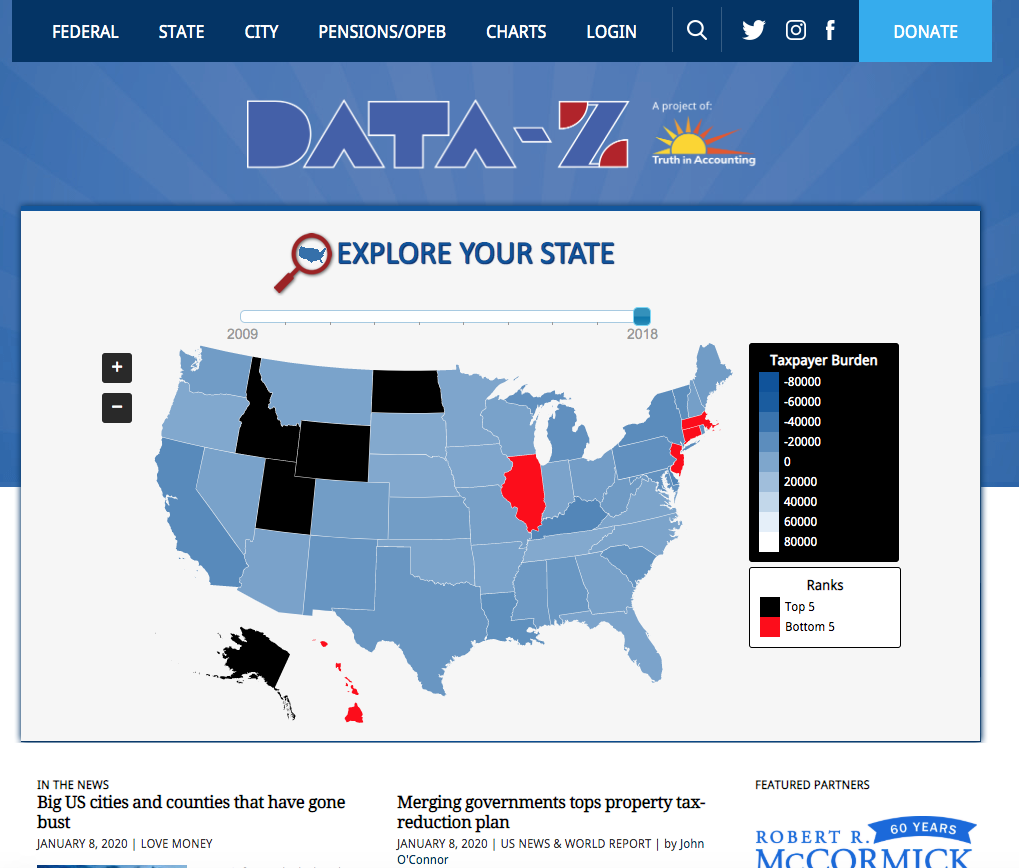
Data-Z (database for state and city data)
Create your own chart with more than 700 data variables at the federal, state, and city levels.
The Pension Time Bomb: Why the GASB’s Accounting Rules Demand Congressional Oversight
April 23, 2026
America’s state and local governments are sitting on a hidden fiscal crisis. Under today’s official accounting rules, hundreds of billions of dollars in underfunded pension promises are not reflected as liabilities in the budgetary fund statements used for budgeting decisions. The result? Distorted budgets, squeezed funding for schools, roads, and public safety, and a massive transfer of costs to future generations.
Regime Change at the Fed: From Big Bank Bailouts to Local Productivity
February 24, 2026
ScheerPost
On January 30, when former Federal Reserve board member Kevin Warsh was nominated by President Trump as the central bank’s next chair, markets sold off and gold and silver plunged. Investors were positioned for a “dove,” someone inclined to cut rates aggressively and keep money loose; and Warsh has a long-standing reputation as a “hawk.”
The Chicago Teachers’ Mystery Audits
February 1, 2026
The Wall Street Journal
The Chicago Teachers Union (CTU) has resisted making its financial audits public, and we are starting to learn why. The union recently produced audits going back to 2020, and the records show that its finances haven’t always received a clean slate by its official independent auditor.
Same States, Same Cities, Same Story: Reason’s Study and the Taxpayer Burden
September 25, 2026
New independent analysis from the Reason Foundation reinforces a message Truth in Accounting has documented for years: many of America’s state and local governments look solvent on paper while their audited balance sheets tell a different story.
Baltimore’s Housing Trust Can Count the Cash, It Still Can’t Count the Homes
September 25, 2026
In November 2016, Baltimore voters did something unusual: they wrote an affordable-housing lockbox into the City Charter. The Affordable Housing Trust Fund [AHTF] was supposed to take a dedicated stream of tax money and turn it into housing for the city’s lowest-income households.
The Charter even said how the public would know whether the city was keeping that bargain. Article I, Section 14 of the Charter gave the Commission two separate jobs, not one. It must “submit an annual report to the Mayor and City Council on the activities and usage of the funds, including tenure (rental and homeownership), income level served, and unit size (number of bedrooms), and make the report available to the public.” Separately, it must “ensure an audit of the fund every four years by a certified public accounting firm.” The four-year audit does not pause the annual report. The Commission must account for the money every year and have an independent CPA review the fund every four years. Both obligations run at the same time.
Letter to Maryland's Comptroller Brooke Lierman
September 18, 2026
Thank you for your service to Maryland. I’m a CPA who started the nonpartisan organization Truth in Accounting (TIA) over 20 years ago with the sole mission to reveal governments’ true financial condition. TIA has analyzed Maryland’s audited Annual Comprehensive Financial Reports since 2009 and was recently engaged by local media outlets to review the state's audited financial statements. And because the Office of the Comptroller is a signatory to the accuracy and completeness of the data presented in those reports, we have questions we believe Maryland taxpayers deserve answered. Please respond by Tuesday, August 25 at noon.
Baltimore Audit Finds a Bigger Problem Than Any Single Finding: Weak Controls Across the City
September 8, 2026
Baltimore’s 2025 Single Audit points to a broader problem than any one accounting error or compliance issue. Across the city’s finances, auditors repeatedly found the same underlying weaknesses: late reviews of account balances, fragmented responsibilities across departments, weak monitoring, and internal controls that failed to catch problems before year-end. Those breakdowns affected everything from cash and grant reporting to utility billing and cybersecurity.
Get this in your e-mail. Subscribe below.